
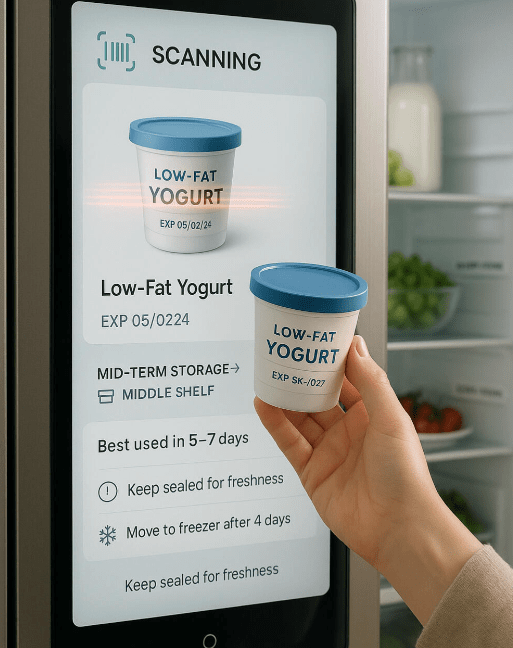
Some of you may not know this but in the U.S., Samsung has launched a pilot program on your fridge door.
The move to introduce advertising on its high-end Family Hub refrigerators, is not just a commercial strategy; it could well become a critical inflection point in the relationship between consumers, premium appliances, and digital privacy.The Premium-for-Privacy Paradox
At the heart of the controversy is the “premium-for-privacy paradox.” Consumers pay a premium price for a smart refrigerator — a device intended to be a long-term household investment — only to have its core functionality repurposed for marketing. This erodes the fundamental expectation of ownership. Instead of a purchased appliance, all of a sudden, your fridge is now an ad-delivery platform straight in your home.
The inability to fully opt out, if finally rolled out, is another privacy nightmare. While users can employ limited workarounds, such as switching to a photo slideshow or “Art Mode,” the advertisements cannot be entirely disabled without physically disconnecting the fridge from the internet. Since premium features like shopping list syncing and remote camera viewing require connectivity, Samsung creates a forced connectivity scenario. Consumers are essentially penalized with reduced functionality if they choose to prioritize an ad-free, private experience.
The Specter of Invasive Data Collection
While Samsung has affirmed it is not collecting ad interaction data during the initial pilot, the infrastructure for a far more invasive reality could become permanently installed in the kitchen.
The kitchen is one of the most intimate spaces in the home. The smart fridge, with its internal cameras and usage logs, can generate highly granular data streams, including food inventory, meal times, and shopping routines. If this data is later combined with a user’s existing profile from other Samsung devices — such as smart TVs, phones, or wearables — it creates a detailed digital profile. AI can then make deep inferences about lifestyle information — dietary habits, household traffic, and family schedules — which could be exploited for highly precise, invasive ad targeting, often without explicit consent.
Weakening the Home Network’s Defense
Every Internet-connected device adds to the home’s security risk, and the smart fridge is no exception. By adding another node to the network, Samsung increases the overall attack surface. If a vulnerability is discovered in the fridge’s software, it offers a potential entry point for hackers.
Normalizing Surveillance Advertising
Ultimately, Samsung’s move contributes to the normalization of “surveillance advertising” within the last remaining private space: the home. This trend aims to transform all purchased appliances into continuous revenue streams, shifting the commercial relationship from a one-time transaction to one of ongoing, mandatory engagement.
From moves like this, now and in the recent past, this seems to be the start of the slow erosion of people’s privacy under the balen of “consumerism”. As more devices in the home become ad-supported, consumers may begin to accept that commercial influence and continuous monitoring are simply unavoidable costs of having a “smart” life. This shifts the burden of managing digital privacy from the corporation, which benefits from the data, entirely onto the consumer, who must constantly monitor and manage a growing number of complex settings across disparate devices.
For this and many more such deep dives into digital privacy, subscribe to My Data Zero newsletter and stay informed.