
In Parts 1 and 2, we unmasked the “Silent Observers” in your home and the “Digital Twin” used to model your life for profit. Now, we move from awareness to action. In the age of “Surveillance Capitalism”, privacy is no longer a default setting—it is a tactical achievement.
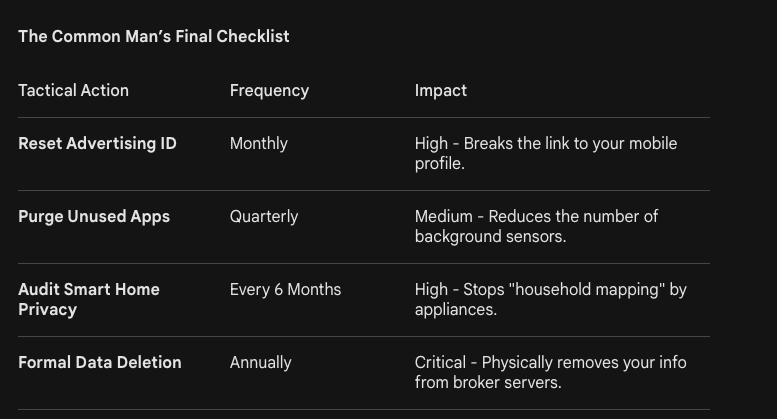
To “darken” your footprint, you don’t need to live in a cave; you simply need to change the math. By cutting off the most aggressive data siphons and legally demanding your records back, you can dismantle the ghost profile that corporations have built in your name.
This is your 2026 survival guide.
Step 1: Harden the Hardware (The Physical Kill-Switch)
Your first line of defense is physical. If a device cannot “see” or “hear,” it cannot contribute to your “Digital Double”.
- The Camera Cover: Use simple privacy sliders on every laptop, tablet, and smart display. If a device has a camera you don’t use (like a smart fridge), black electrical tape is your best friend.
- The “Zero-Power” Rule: Use smart plugs to completely cut power to your Smart TV and gaming consoles when not in use. “Standby mode” is often when these devices perform their most aggressive data uploads.
- The Faraday Pouch: When traveling to sensitive locations (doctors, lawyers, or protests), place your phone in a Faraday bag. This blocks all cellular, Wi-Fi, and Bluetooth signals, preventing “location breadcrumbs” from being logged by nearby towers or retail beacons.
Step 2: Poison the Well (Data Obfuscation)
Since the AI depends on clean, predictable data to model you, the most effective defense is to feed it “noise.” This is known as “Data Obfuscation”.
- Algorithmic Confusion: Use tools like “AdNauseam” (a browser extension) that clicks every ad in the background. If the system thinks you are interested in everything—from luxury yachts to industrial tractors—your profile becomes commercially useless.
- The Search Pivot: Stop using Google for personal queries. Switch to DuckDuckGo or Brave Search, which do not tie your search history to a persistent ID.
- Virtual Credit Cards: Use services like Privacy.com to create one-time-use virtual cards. This prevents data brokers from linking your physical purchase history (the “what”) to your real identity (the “who”).

Sign up for “The Privacy Vault” by My Data Zero. This is our free membership area that gives readers the tools, knowledge, and community platform to stay secure in a connected world.
Step 3: Exercise Your Legal “Right to Erase”
In 2026, the law is finally catching up to the tech. Depending on your region (GDPR in Europe, CCPA/CPRA in California, or similar emerging laws globally), you have the legal right to see and delete your data.
- Send a “Subject Access Request” (SAR): Use templates from the Electronic Frontier Foundation (EFF) to demand that major data brokers (like Acxiom or Oracle) show you exactly what they have on you.
- The “Delete Me” Strategy: Use automated services such as Incogni or DeleteMe. These services act as your “digital lawyer,” constantly scanning the web for your info and sending legal take-down notices to hundreds of data brokers on your behalf.
- Global Privacy Control (GPC): Enable the GPC signal in your browser settings. This tells every website you visit that you legally opt-out of the “sale or sharing” of your personal information.
Reference Sources for Part 3:
- Electronic Frontier Foundation (EFF): The Surveillance Self-Defense Guide
- Privacy Rights Clearinghouse: How to Opt-Out of Data Brokers
- Global Privacy Control: Official GPC Specification
- Consumer Reports: How to Set Up a Secure Guest Network
Series Conclusion: The invisible dragnet is vast, but it is not invincible. By treating your data as a high-value asset rather than a byproduct of convenience, you reclaim the one thing “Surveillance Capitalism” tries to take: your freedom to live unobserved.
Leave a Reply