Readers: This blog post uses the Digital Visibility Spectrum to help you understand that privacy isn’t a “yes/no” switch as you thought earlier — it’s a sliding scale.
Beyond “Private” and “Public”: Navigating Digital Visibility Spectrum
In the early days of the Internet, we were told that if you put something online, it was “public,” and if you kept it on your hard drive, it was “private.”
By 2026, that binary is dead.
Today, AI agents crawl our social feeds, “cookies” have been replaced by sophisticated behavioral fingerprints, and your data lives in a constant state of flux. To protect yourself, you need to stop thinking about privacy and start thinking about visibility.
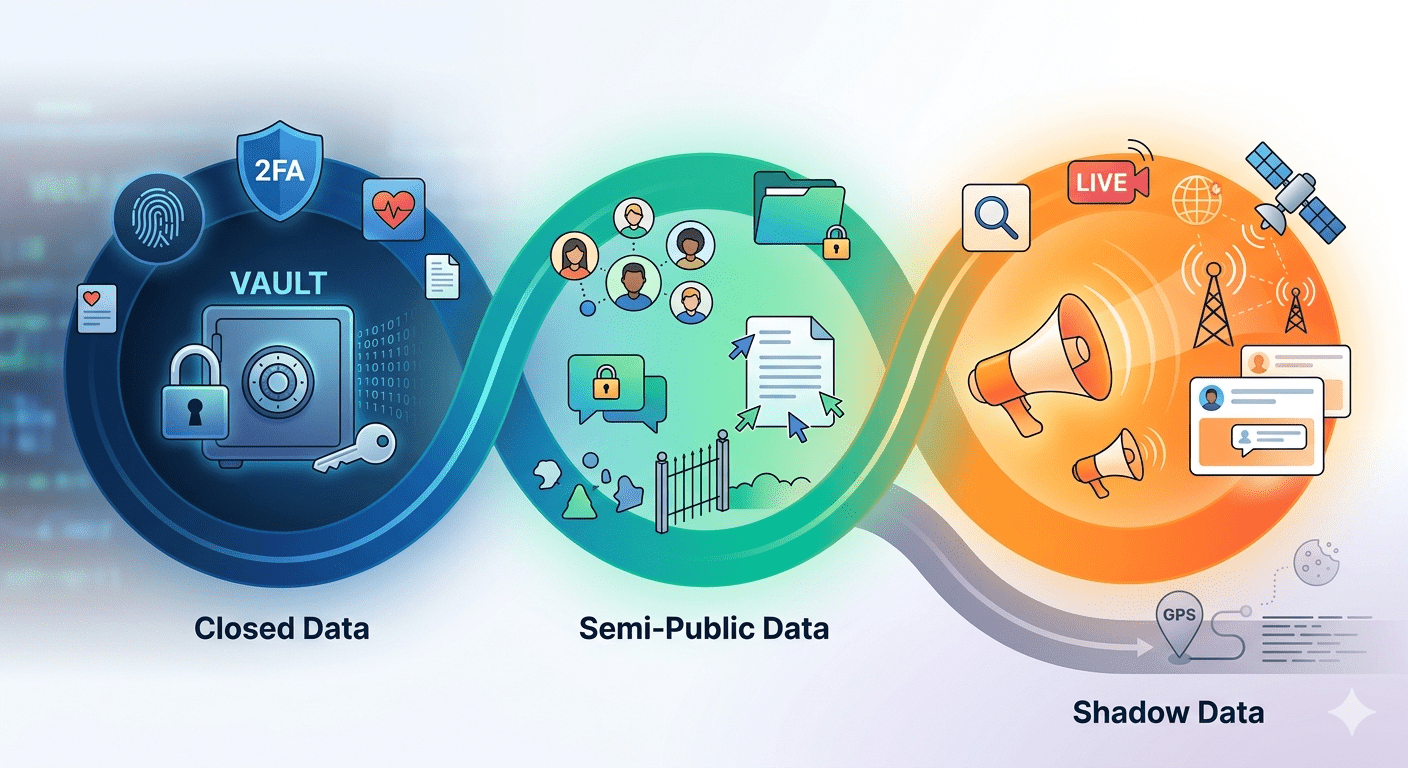
Here is the Digital Visibility Spectrum — a framework to help you understand where your data lives and who can see it.
1. Closed Data (The “Vault”)
What it is: Information intended only for you or a specific legal entity.
Behavior: This is the data you expect to be “locked.”
- Examples: Your Social Security Number, banking passwords, private medical records, and your raw DNA data.
- The 2026 Reality: Even “closed” data is at risk due to third-party breaches. Your behavior here should be zero-trust. If a service doesn’t need your phone number or SSN to function, don’t give it.
2. Semi-Public Data (The “Walled Garden”)
What it is: Data you share with a specific, “trusted” group.
Behavior: This is where most of us live. We think it’s private, but it’s actually “restricted public.”
- Examples: Your “Friends Only” Facebook posts, a private Instagram account, or a shared work folder in Slack or Google Drive.
- The 2026 Reality: This is the most dangerous zone for “Context Collapse.” A friend can screenshot your private post, or an AI model trained on “internal” data might accidentally leak the sentiment of your private chats.
- The Rule: If you wouldn’t want it on a billboard, don’t assume the “walled garden” is soundproof.
3. Public Data (The “Town Square”)
What it is: Anything that can be indexed by a search engine or seen by a stranger without an invite.
Behavior: This is your digital billboard.
- Examples: Your LinkedIn profile, public tweets/posts, comments on news sites, and your Venmo transaction feed (if not set to private!).
- The 2026 Reality: In the age of Generative AI, public data is “food.” AI models use your public posts to “learn” who you are, what you like, and how you speak. This data is now permanent and searchable in ways Google never was.
4. Shadow Data (The “Invisible Trail”)
What it is: Data you don’t “post,” but you “emit.”
Behavior: This is the spectrum’s newest and most complex end. You don’t choose to share this; it happens as a byproduct of being online.
- Examples: Your IP address, how long you hovered over a specific photo (dwell time), your physical location via GPS, and your typing rhythm.
- The 2026 Reality: This “shadow” data is often used to move you from an anonymous user to a “profiled” one. Companies use it to predict your next purchase or even your political leanings.
The “Visibility Audit”: 3 Questions to Ask Yourself
To take control of your place on the spectrum, run every digital action through these three questions:
- Who is the Audience? Is this for me (Closed), them (Semi-Public), or everyone (Public)?
- Is it “Leaking”? Am I giving an app my location (Shadow Data) just to read a recipe?
- What is the “Half-Life”? Will I be okay with this “Public” post being part of my digital identity in five years when an AI summarizes my life for a potential employer?
The Bottom Line
The “Average User” isn’t someone who hides from the internet; it’s someone who knows which “room” they are standing in. By understanding the Digital Visibility Spectrum, you move from being a passive generator of data to an active manager of your digital life.
What part of your “Digital Footprint” surprised you the most when you looked into it? Leave your views in the ‘Comment’ section.