
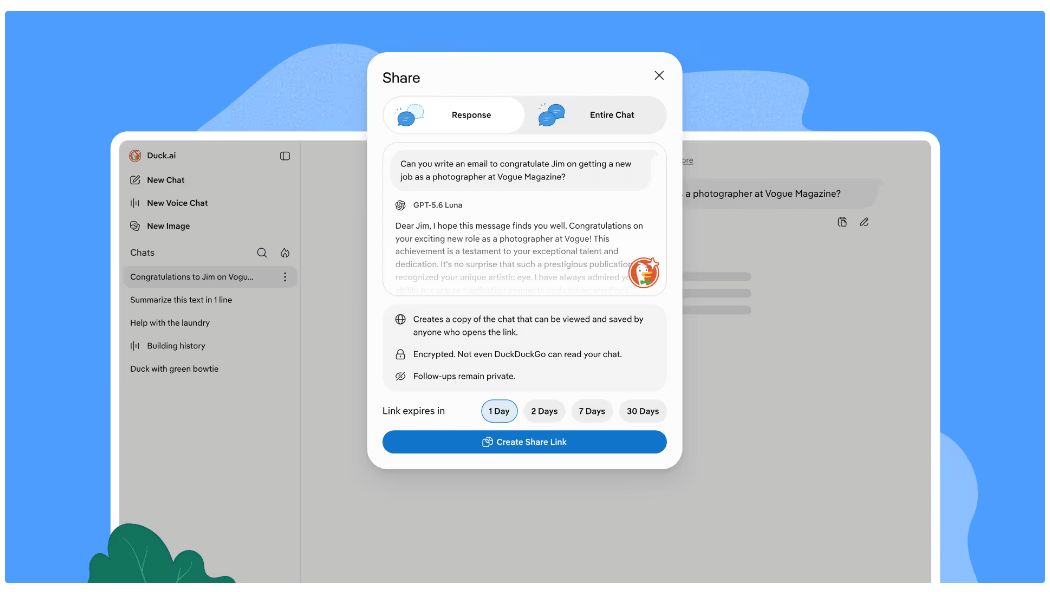
DuckDuckGo has introduced a way for users of its Duck.ai chatbot to share conversations through links while keeping the chats encrypted and inaccessible to DuckDuckGo itself.
The feature, announced on 7 October, is designed to address one of the main weaknesses of private AI chats: sharing a useful conversation usually means copying and pasting the text, rather than allowing someone else to see and continue the discussion. Spread Privacy
DuckDuckGo said shared conversations are encrypted on the user’s device before being uploaded, with the decryption key contained in the link itself rather than being stored on its servers.
The company said the link effectively contains two separate elements, an identifier that tells its servers which encrypted conversation to retrieve and a key contained after the # symbol that allows the recipient’s browser to decrypt the conversation.
Because information after the # in a web address is normally not sent to the server in requests, DuckDuckGo said it does not receive the key and has tested the system to ensure it does not enter its telemetry, error reports or other logs.
The company said shared links are long and randomly generated to make them difficult to guess, while shared-chat pages are configured to prevent search engines such as Google from indexing their contents.
Links expire after 48 hours by default, although users can choose expiry periods of one, two, seven or 30 days, or delete a link sooner through Duck.ai’s settings.
The feature builds on DuckDuckGo’s existing privacy measures for Duck.ai, which route requests to AI model providers through DuckDuckGo so providers do not see users’ IP addresses, while chats are not used to train AI models and normal chat histories are stored locally on users’ devices.
There is, however, an important limit to the protection: once a person has access to a shared conversation, DuckDuckGo cannot prevent them from saving, copying or sharing its contents elsewhere.
DuckDuckGo said it designed the system partly in response to incidents involving shared conversations from other AI services appearing in search results, sometimes exposing users’ names and other personal information.
Unlike those cases, DuckDuckGo said its shared chats are not discoverable through search engines, are encrypted with a key the company does not possess and automatically expire rather than remaining permanently accessible.
The development reflects a broader challenge for AI companies as chatbots become tools for research, coding, shopping and planning, creating demand for ways to collaborate on AI-generated work without turning private conversations into publicly accessible web pages.
The key distinction is that DuckDuckGo is not claiming that a shared chat remains private from the recipient. The privacy protection is primarily against DuckDuckGo, AI providers, search engines and accidental public discovery; anyone you deliberately give the link to can still copy or redistribute the conversation. Spread Privacy
Image credit: DuckDuckGo
Leave a Reply