

Looking for work these days means handing over your resume, your phone number, your work history, and often your date of birth to a website you have never fully vetted.
For most job seekers, this feels routine. It should not.
A growing body of research shows that many of the world’s most popular job search platforms collect far more personal data than required, and a troubling share of that data ends up with third parties the applicant never agreed to.
Latest Research
A 2026 report from privacy company Incogni surveyed 1,000 US workers who had used nine leading job search, recruitment, and professional networking platforms, and reviewed each platform’s privacy policy and legal disclosures.
The findings were stark.
ZipRecruiter, Monster and LinkedIn were categorized as the most privacy-invasive platforms among those evaluated. Much of their lower performance was tied to the Transgressions category, which accounts for incidents such as regulatory fines, lawsuits and data breaches. So, according to the report, ZipRecruiter, Monster and LinkedIn come in at the top of the ranking (meaning they’re the most privacy-invasive of the set).
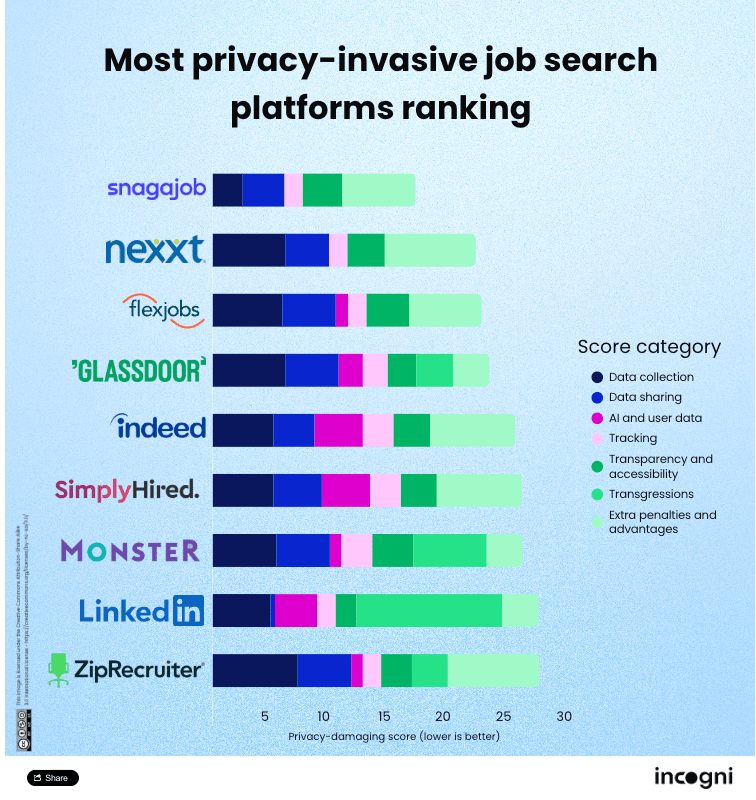
Several job search platforms, however, also emerged as stronger performers in a new privacy ranking conducted by Incogni, with Snagajob, FlexJobs and Glassdoor receiving some of the highest marks for user privacy protections. Snagajob led the group, earning top marks for the way it handles user data collection and performing strongly in the tracking category. Incogni’s researchers also reported finding no major “transgressions” associated with the platform, such as lawsuits, regulatory actions, data breaches or other notable privacy concerns that were not already reflected in the ranking methodology.
FlexJobs also ranked favorably, standing out in the study’s additional considerations category, which evaluates a range of privacy-related factors beyond core data collection and tracking practices. Glassdoor received recognition for maintaining a relatively accessible privacy policy and offering user-friendly privacy resources. Those features helped the platform gain points in Incogni’s extra penalties and advantages category.
What makes job applications riskier is how little applicants understand about where their information goes. For example, the Incogni research found that more than a third of respondents believed platforms only shared their data with prospective employers. Nearly half admitted to skimming privacy policies rather than reading them, and 40% never delete the profiles they create. A quarter could not even recall which platforms still held their data.
Separately, the report noted that most of these privacy policies were written at a college graduate reading level and would take roughly 35 minutes to read in full, meaning that even applicants who try to read them often cannot fully understand what they are agreeing to.
The stakes are not abstract. Incogni pointed out that thousands of people rely on these platforms as an essential resource while job hunting, and yet only a small fraction express any concern about how their personal information is being used.
Scams Compound Privacy Problem
Data misuse is not limited to legitimate platforms selling information to advertisers. Fraudulent job postings have become a parallel threat. Industry estimates suggest a notable share of online job postings are either ghost listings with no real hiring intent or outright scams designed to harvest personal details.
A 2026 Norton survey found that roughly a third of US respondents had encountered a job scam or suspicious posting, and almost a quarter of those people went on to lose money, with average losses running into the thousands of dollars.
Younger job seekers appear especially exposed. LinkedIn’s own research found that Gen Z applicants are far more likely than older generations to fall for scams, often because economic pressure pushes them to overlook warning signs.
These scams frequently impersonate recognisable employers and government agencies, then ask applicants to share sensitive details such as a Social Security number, bank information, or scanned identity documents early in the process, long before any legitimate employer would request them.
Why This Matters For New Job Applicants
First time job seekers are particularly vulnerable because they have not yet learned what a normal hiring process looks like. They may not know that a real employer rarely asks for banking details before an offer, or that uploading a resume to five different sites means five different companies now hold a copy of personal contact information indefinitely.
Seven Steps Job Seekers Can Take To Protect Their Data
1. Limit what you share and where
Avoid uploading your full resume, including a home address or date of birth, to every platform you browse. Many sites do not require this level of detail just to search listings.
2. Use a dedicated email and phone number
Create a separate email address solely for job applications, and consider a virtual or secondary number. This keeps scam contact attempts away from your primary accounts.
3. Read platform privacy settings, not just policies
Most major job sites allow you to limit who can view your full profile or resume. Adjusting these settings can reduce unwanted data sharing without hurting your visibility to genuine recruiters.
4. Verify before you apply
Check whether a posting also appears on the company’s own careers page. Listings that exist only on third party boards, with no trace on the employer’s official site, deserve extra scrutiny.
5. Never pay or share financial details upfront
Legitimate employers do not charge application fees or request bank details before a formal offer. Treat any such request as a red flag.
6. Clean up old profiles regularly
Delete accounts and resumes from platforms once your search ends. Dormant profiles are exactly the kind of forgotten data that increases exposure if a platform is breached.
7. Report suspicious postings
Flagging fake listings to the platform, and to consumer protection bodies in your country, helps limit the damage to other applicants.
Job hunting already asks a great deal of patience and resilience. It should not also require gambling with personal data. A little caution at the application stage can prevent a much larger headache later.
What do you have to say about this article? Feel free to comment or share your experience.