Most of us live with a comforting, reassuring illusion about privacy in our daily routines. We lock our front doors, pull down our blinds, and assume that whatever happens behind closed doors stays entirely private.
Our homes are supposed to be our final sanctuaries, the one place where we are completely unobserved and safe from the outside world. However, there are smart home security risks that can blur that boundary and remind us that security is never absolute.
Yet, that belief is dangerously outdated.
Additionally, you do not need a burglar picking your lock. Nor a government agent tapping your phone lines to invade your privacy anymore. You invited the surveillance in yourself.
These Are The Intruders
When we pack our living spaces with connected devices, smart appliances, and automated conveniences, we throw open the back door to digital intruders. If you think you are safe inside your home behind closed doors, you are wrong. Unwanted eyes and ears are already inside, watching your routines, mapping your layout, and listening to your private conversations without your knowledge.
The Trojan Horse on Your Doorstep and Walls
The modern smart home is marketed as a bubble of safety and effortless comfort. Here are some smart home security risks. We buy video doorbells to catch package thieves, smart speakers to play music on command, connected refrigerators to manage grocery lists, and robotic vacuums to keep our floors spotless. But every single one of these gadgets is a data collection endpoint.
Consider the ubiquitous video doorbell. Millions of households install smart cameras like Amazon Ring to monitor their front porches. While marketed strictly as exterior defense tools, they frequently blur the lines of domestic privacy. The real danger surfaces when security lapses turn those protective shields into open windows for strangers.
In multiple high profile security failures, hackers have exploited weak credentials, credential-stuffing attacks, and software vulnerabilities to hijack home security cameras. Families have experienced terrifying intrusions where hackers used two-way talk features to scream obscenities, demand ransoms, or directly address children in their bedrooms. In one widely reported case, an attacker gained control of a camera installed in a child’s bedroom and taunted the young occupant. These incidents prove that the tools designed to keep intruders out can easily be repurposed by malicious actors to move right inside your living space.
Moving past the front door, the invasion continues into the kitchen and living room.
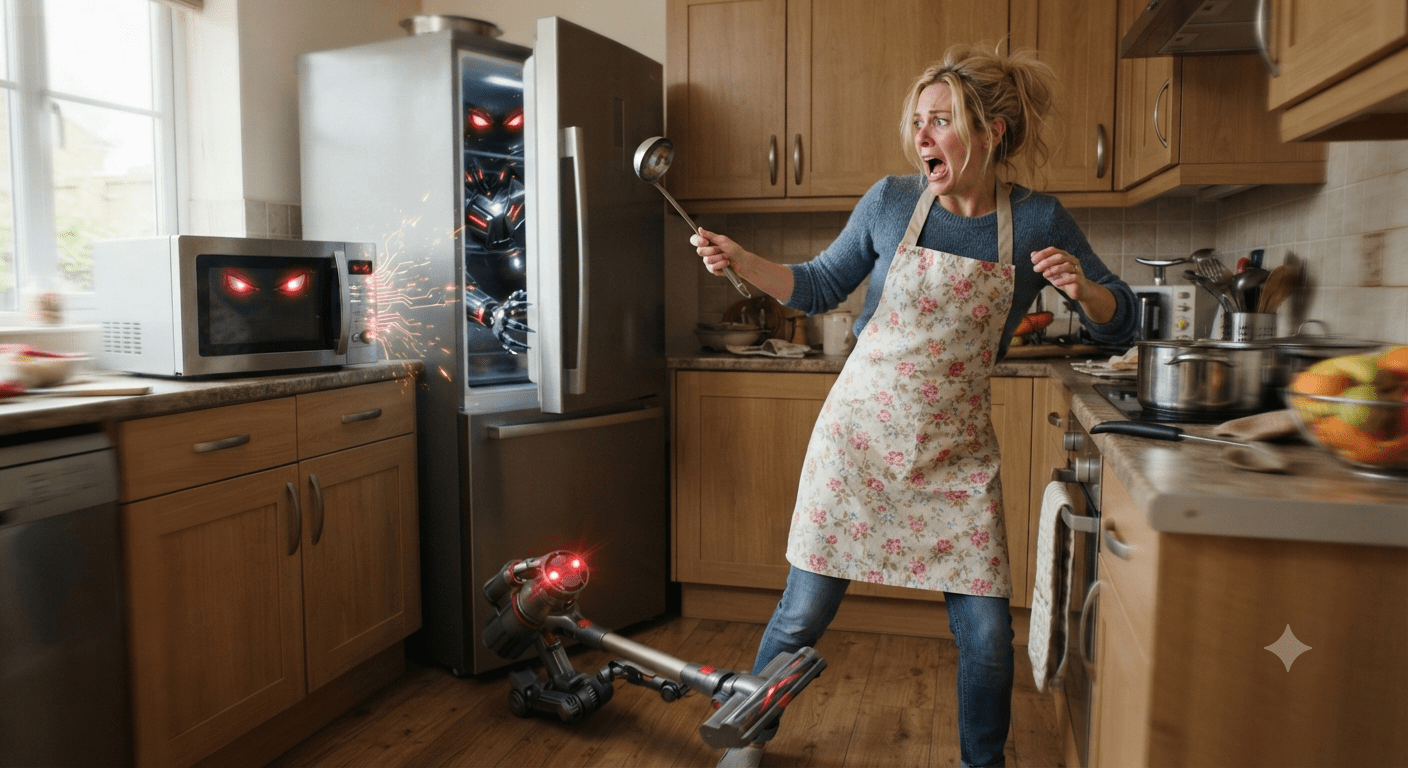
Smart refrigerators equipped with touchscreens, internal cameras, and voice assistants run complex operating systems. These systems often feature outdated software libraries or unpatched security flaws.
The smart fridge sits on the same local Wi-Fi network as your personal computers, smartphones, and work laptops. A compromised refrigerator can serve as a backdoor for hackers to scan your entire home network. It can harvest your Wi-Fi passwords and steal your personal data. Additionally, this creates smart home security risks.
Even robotic vacuums, long viewed as harmless mechanical pets, have a dark side. Models built with optical mapping and AI navigation have been caught capturing raw photographs inside private homes—including intimate settings like bathrooms—which were then shipped off to third-party contractors for data labeling. The mundane machinery humming quietly in the background of your daily life is constantly cataloged and transmitted to corporate cloud servers.
How Convenience Undermines Security
The core problem with the connected home revolution is a massive mismatch between consumer expectations and corporate priorities. Manufacturers rush complex, internet-connected computers disguised as household appliances to the market, prioritizing rapid deployment and convenience over foundational security.
When you buy a smart thermostat or a connected oven, you are trusting the manufacturer to maintain rigorous cybersecurity standards. Yet, many of these devices ship with weak default passwords, lack proper data encryption, or stop receiving software updates after a couple of years. This leaves millions of households exposed to automated botnets and cybercriminals scanning the globe for vulnerable Internet of Things devices.
Furthermore, the data harvested by these appliances paints an uncomfortably intimate portrait of your daily existence. Your smart speakers log your voice commands, your smart TV tracks your viewing habits and conversational background noise, and your connected lighting system logs exactly when you wake up and go to sleep. This information is bundled, analyzed, and monetized, turning your private domestic habits into corporate commodities.
Here’s How To Reclaim Your Private Space
You do not necessarily have to live like a hermit or throw away every smart device you own, but you do need a drastic shift in mindset. Protecting your home requires treating connected appliances not as passive furniture, but as networked computers that demand strict security boundaries.
- Isolate Your Network: Never keep your smart appliances on the same Wi-Fi network as your primary computers, phones, or work devices. Set up a separate guest network or a dedicated virtual local area network for your IoT gadgets so that if a smart fridge or bulb is compromised, hackers cannot access your personal data or main computer.
- Enforce Strict Access Control: Change every default factory password immediately. Use long, unique passphrases generated by a password manager for every single device and enable multi-factor authentication wherever it is offered.
- Minimize Connectivity: Ask yourself if an appliance actually needs internet access. A smart toaster or refrigerator does not need cloud connectivity to function as a basic appliance. Deny unnecessary permissions and opt out of data collection during setup.
- Regularly Update Firmware: Treat your appliances like smartphones. Check for and apply software updates regularly to patch known security vulnerabilities before malicious actors can exploit them.
The illusion that our homes are impenetrable walls protecting us from intrusion is fading fast.
Moreover, true security in the digital age requires vigilance and skepticism.
Additionally, it also demands we refuse to trade privacy for domestic convenience.