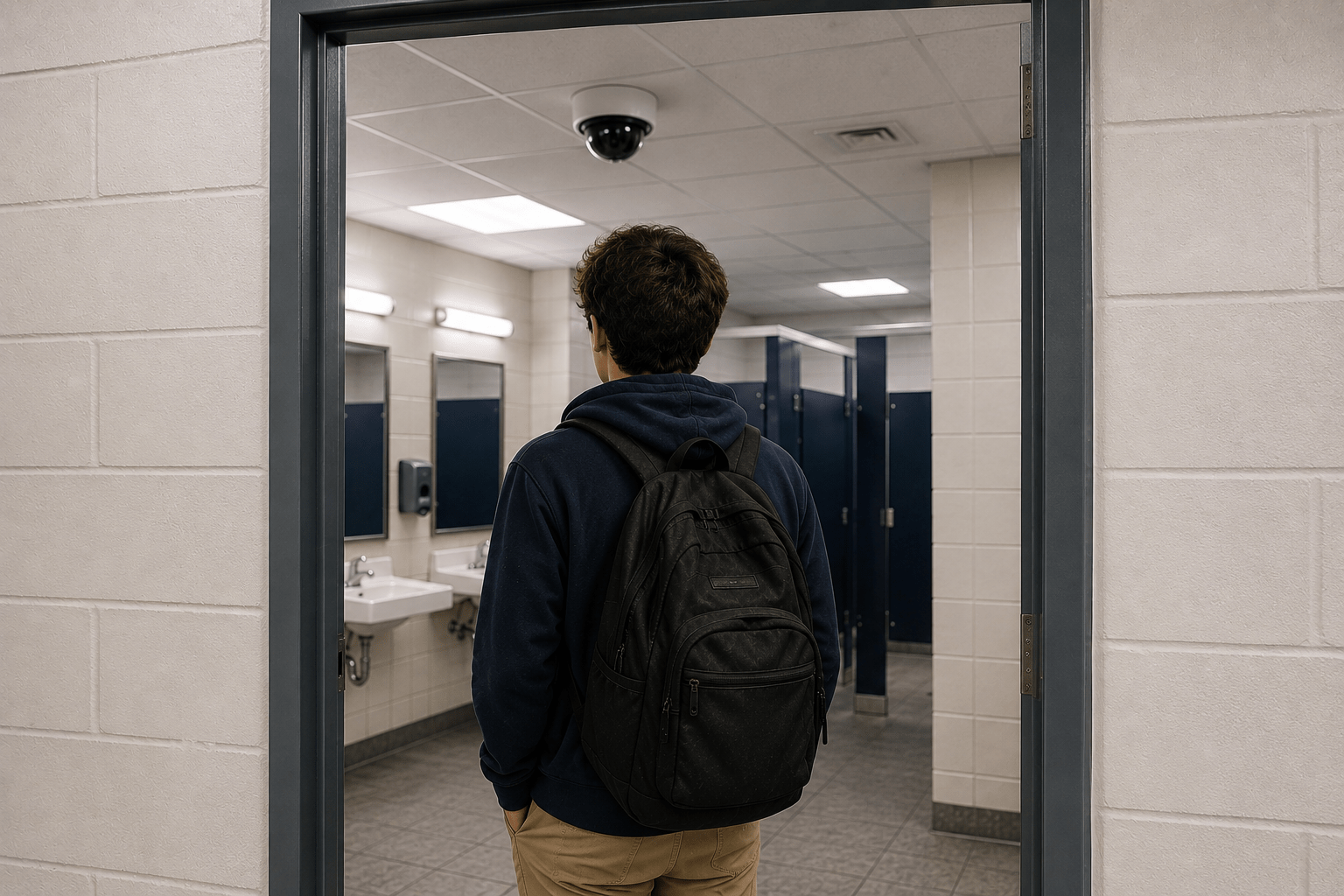
The conversation about personal data security usually focuses on phones, browsers, or social media feeds. Yet a more physical, invasive trend quietly unfolds in the real world. CCTV cameras and monitoring systems creep into spaces once thought immune, including public school restrooms and school restroom surveillance.
The Illusion of Inevitability in Public Spaces
It is easy to feel like physical privacy is a relic of the past. Walk down any city street, enter a shopping mall, or check into a transit hub, and lenses are tracking your every move. We have grown so accustomed to surveillance that constant monitoring feels like an unavoidable tax for living in a modern society.
But when this mindset starts creeping into public and private schools, it begins to normalize a culture of continuous tracking for developing minds.
Schools are supposed to be safe havens that foster growth, trust, and community. When administrators install monitoring systems in sensitive zones like washroom corridors or washbasins, they send a toxic message. They teach children that privacy is conditional, that authority figures inherently do not trust them, and that being watched at all times is normal.
But once society accepts that safety justifies erasing privacy in a school restroom surveillance setting, that logic expands everywhere else. We slide rapidly toward a reality where opting out of surveillance is treated as suspicious behavior.
The Cost of Losing Personal Space
Privacy is not just about hiding wrongdoing or having something to conceal. It is a fundamental psychological necessity. Every human being needs moments of solitude and personal space to breathe, make mistakes, and exist without being cataloged, judged, or recorded.
When monitoring systems infiltrate sensitive zones like school restrooms, they trigger immediate psychological damage. Students experience a chilling effect on their natural behavior, leading to heightened anxiety, self-consciousness, and stress.
Furthermore, video and audio feeds captured in semi-private spaces rarely stay secure. They are stored on local servers, sometimes processed via automated software or cloud networks, and left vulnerable to human error, data breaches, or malicious leaks.
Real World Flashpoints and Public Outrage
The installation of cameras in school restrooms is not a hypothetical nightmare. It is happening in the real world, and it consistently triggers severe public backlash and legal turmoil.
In Pune, India, a private school faced massive outrage after students discovered a camera near washbasins in a girls’ washroom. School management argued the device was meant to monitor property damage. This raised concerns about school restroom surveillance. The situation escalated when an angry crowd stormed the school premises. They confronted the administration, drawing widespread media attention and prompting police intervention.
Similar controversies have unfolded internationally. Investigations by privacy advocacy groups in the United Kingdom (UK) revealed multiple instances where secondary schools installed surveillance cameras facing or inside sensitive areas like toilets and changing rooms under the banner of cracking down on truancy and vaping.
In some American and international public schools, the explosion of discreet e-cigarettes/vapes in restrooms has driven administrators to desperation. This led to some districts mistakenly attempting to install visible cameras (leading to immediate lawsuits from civil rights organizations for violating constitutional privacy and the Fourth Amendment).
Civil liberties organizations have condemned such practices, emphasizing that monitoring children near restrooms creates severe safeguarding risks rather than solving discipline problems. In even more extreme cases, unauthorized hidden spy cameras discovered in student washrooms have sparked full scale criminal investigations and immediate protests.
Smart Alternatives That Respect Privacy
But here’s some cheer. The good news is that schools do not have to necessarily choose between maintaining order and respecting privacy, for modern technology offers incredible, privacy-compliant alternatives that catch bad behavior without ever pointing a camera lens at a student.
Here are a few:
Chemical and Air Quality Sensors
Devices like the HALO Smart Sensor and Triton Systems monitor air quality, chemical signatures, and vape aerosols without containing any cameras or video recording tools [cite:]. They detect illicit substances or heavy smoke instantly, sending a silent alert to school authorities while keeping visual privacy completely intact.
Acoustic Aggression and Sound Monitors
Instead of recording private conversations or watching students, smart acoustic sensors listen exclusively for decibel spikes. They can recognize the sharp sounds of a physical fight, smashing doors, or specific distress keywords like shouting for help. School staff receive immediate notifications about disturbances without any violation of personal conversation or visual space.
Radar Based Occupancy and Loitering Tracking
Using privacy-compliant radio waves or low-power radar instead of optical lenses, these systems monitor how many bodies are inside a room and how long they stay. If a group of students crowds into a single stall to bully or vape, or if someone remains locked inside past a safe time limit, the system flags the issue by tracking physical presence and volume rather than identity or visual form.
Smart Digital Pass Systems
Preventative architecture focuses on stopping trouble before it starts. Platforms like SmartPass manage student movement and hallway traffic dynamically. By regulating how many students leave different classrooms at the same time, schools eliminate the unsupervised crowd congestion in corridors and restrooms that typically breeds bullying and peer pressure.
Preserving Privacy Within the Law
In conclusion, protecting children and respecting privacy are not mutually exclusive goals. When schools resort to placing cameras in toilets and private washrooms, they abandon trust in favor of heavy-handed control, often violating the legal and ethical boundaries of personal privacy. By embracing innovative, non-invasive tools like acoustic monitors, air quality sensors, and smart traffic management, educational institutions can maintain safety and order without turning a sanctuary of learning into a surveillance state. Reclaiming our boundaries starts with drawing a hard, immovable line around where the lens is allowed to look.
Reference:
- The Times of India – Pune School Principal Assaulted Over CCTV in Washroom Common Area
- The Print – Maha: Principal Assaulted After Parents Accuse Pune School of Putting CCTV Camera in Washroom
- The Hindu – Pune School Principal Assaulted Over Allegations of Installing CCTV in Girls’ Washroom
- HuffPost UK – More Than 200 Schools Use CCTV Cameras in Toilets or Changing Rooms, Claim Big Brother Watch
- Big Brother Watch – Privacy Investigations and Reports on School Restroom Surveillance